
Can AI Detect Human Actions? From Physical Movement to Written Content
Can AI detect human actions? The short answer is yes, but the technology involved depends entirely on what you mean by "action."

In the past, detecting an action meant one thing: video surveillance. A camera would flag if someone was running, falling, or loitering. Today, however, AI models have evolved to recognize actions across three distinct layers. It is no longer just about watching your body move; it is about analyzing how you interact with devices and even how you formulate thoughts.
To understand what modern AI can really do, we need to break these actions down into three main categories:
1. Physical Actions (Computer Vision)
This is the traditional definition of Human Action Recognition (HAR). Using Computer Vision, AI analyzes video feeds to identify specific bodily movements.
- How it works: Software maps the human skeleton (pose estimation) to track joints and limbs in real time.
- Examples: A smart gym camera counting your squats, a self-driving car predicting where a pedestrian will walk, or a security system detecting a fall in a nursing home.
2. Digital & Behavioral Actions (Fraud Prevention)
Between physical movement and creative thought lies the layer of Behavioral Biometrics. Here, AI detects the "micro-actions" you perform while using a device. These are unconscious habits that prove you are you.
- How it works: AI monitors how fast you type, the curve of your mouse movements, and the angle at which you hold your phone.
- Examples: Banking apps checking if a bot is moving the mouse too perfectly, or CAPTCHA systems verifying you aren't a robot based on how you click a checkbox.
3. Cognitive & Creative Actions (Natural Language Processing)
This is the newest frontier: detecting the action of writing. Writing is a deliberate human action that leaves behind a unique fingerprint of style, tone, and logic.
- How it works: Natural Language Processing (NLP) models analyze text for patterns. They look to see if the words flow with the unpredictable rhythm of a human mind or the statistical perfection of a Large Language Model (LLM).
- Examples: Teachers checking essays for authenticity, editors verifying content, and cybersecurity tools filtering out AI-generated phishing emails.
While physical detection relies on cameras, cognitive detection relies on pattern analysis. As AI writing tools like ChatGPT become common, the ability to verify the "action" of human writing has become just as critical as monitoring physical security.
1. Detecting Physical Actions (Human Action Recognition - HAR)


When most people search for action detection, they are thinking of Human Action Recognition (HAR). This technology allows computers to "watch" video data and understand what is happening. Unlike standard object detection, which simply says "that is a human," HAR analyzes movement to determine what that human is doing.
To do this, AI moves beyond simple images and uses two key technologies:
Pose Estimation: Mapping the Skeleton
Before AI can understand a movement, it has to understand the body. Pose Estimation tools (like OpenPose) connect the dots between key body parts—shoulders, elbows, knees, and wrists.
This creates a stick-figure "skeleton" over the video feed. By tracking the angles between these joints, the AI can tell if a person is sitting, standing, or crouching, even if the lighting is bad or they are wearing baggy clothes.
Spatio-Temporal Networks: Analyzing Time and Space
A still photo of a person with their hand raised is confusing. Are they waving? Reaching for a cup? Or stretching? To figure this out, AI uses Spatio-Temporal Networks.
- Spatial Analysis: Looks at where the body parts are.
- Temporal Analysis: Tracks how those parts move over time.
By processing the "time" element, the AI recognizes speed and direction. This allows it to tell the difference between a friendly wave and a punch.
Real-World Uses
You will see this technology in several places:
- Healthcare: Smart cameras detect falls in elderly care homes, alerting staff immediately without the person needing to press a button.
- Sports: AI analyzes a golfer's swing to improve their form.
- Security: Systems automatically flag aggressive behaviors, like fighting, in crowded areas.
2. Detecting Cognitive Actions: Can AI Identify Human Writing?
When we think of "actions," we usually visualize movement—walking, typing, or gesturing. But writing is a cognitive action. It is the physical result of your thought process. While cameras use Computer Vision to track the body, advanced NLP models are designed to watch the mind.
Just as a security camera identifies a person by their walk (gait analysis), AI text detectors identify a human by how they build sentences. This involves looking past the meaning of the words to measure the math behind them.
The Metrics of Cognitive Action

To figure out if a text was written by a human or generated by a bot, AI looks for two specific patterns:
- Perplexity (The Complexity Score): This measures how "surprised" an AI model is by your word choice. AI generators like ChatGPT are designed to be safe—they choose the most likely next word. Humans are unpredictable. If the AI is surprised by the word choice, it’s likely human.
- Burstiness (The Variance Score): This measures the rhythm of sentences. Human writing is "bursty." We mix short, punchy sentences with long, complex ones. AI models tend to be flat and monotonous, producing sentences of average length to stay grammatically perfect.
The "Cognitive Fingerprint"
The difference between human and AI writing comes down to imperfection.
When you write, you might use a slang term, break a grammar rule for effect, or make a sudden jump in logic. These are the fingerprints of human thought. An LLM, on the other hand, is a calculator. It doesn't "think"; it predicts the next word based on a massive dataset.
Because these differences are often invisible to the naked eye, distinguishing authentic human writing from machine output requires specialized tools.
How AI Text Detectors Work (The Science of Verification)

When AI analyzes the "action" of writing, it doesn’t read for emotion or story. It reads for probability.
AI detectors work by reverse-engineering the logic used by models like ChatGPT. Since LLMs are prediction engines—guessing the next word based on stats—detectors look for text that is too predictable.
Here is the breakdown of the two core metrics:
- Perplexity (Measures "Surprise")
- Low Perplexity: The text is highly predictable. The words follow a logical, statistical path (e.g., "I went to the store to buy..." followed by "groceries"). This signals AI generation.
- High Perplexity: The text is chaotic, creative, or uses unexpected phrasing. The AI is "surprised" by the word choice. This signals Human writing.
- Burstiness (Measures "Rhythm")
- Low Burstiness: The sentence structure is flat. Every sentence is roughly the same length. It feels robotic and steady. This is a hallmark of AI.
- High Burstiness: The writing has a beat. Humans naturally mix short sentences with long ones. We change our structure to emphasize points. This variation indicates a Human.
The Bottom Line: AI detectors are looking for the "fingerprint" of statistics. If your writing is mathematically perfect, it gets flagged. If it varies in structure and tone, it passes as human.
The Best Tool for Verifying Human Written "Actions"
When moving from physical motion to cognitive action, the "camera" changes. You can’t use a lens to see if a human wrote a paragraph; you need a tool capable of analyzing the subtle patterns of human thought.
For content creators, students, and editors, the most reliable solution for this is the Lynote AI Detector.
Why Lynote Stands Out
Generic checkers often flag false positives because they look for simple keyword matches. Lynote uses advanced context analysis. It treats writing as a complex action, analyzing flow, syntax, and vocabulary depth.
- Deep Pattern Analysis: Unlike basic tools that only catch older AI text, Lynote is trained to distinguish patterns from the newest models, including GPT-4, GPT-5, Claude 3, and Gemini.
- Zero Barriers: Speed matters. Lynote is 100% Free & Unlimited. There are no credit caps, and crucially, No Sign-up is required. You do not need to create an account to get enterprise-level detection.
Visualizing the Verification Process

When you analyze text with Lynote, you aren't just given a vague "Yes" or "No." The tool breaks down the probability of the content being human versus AI.
| Metric | What It Measures | Lynote Analysis Example |
|---|---|---|
| Human Probability | The likelihood the text contains natural “burstiness” and nuance. | 98% Human (Green Indicator) |
| AI Probability | The likelihood the syntax matches LLM patterns (predictability). | 2% AI (Low Risk) |
| Sentence Highlight | Visual cues showing exactly which sentences feel robotic. | Specific sentences highlighted in Red/Yellow |
| Overall Verdict | The final assessment of the “Cognitive Action.” | “Highly likely to be Human” |
By using a tool that understands the structure of writing rather than just the words, you ensure that genuine human effort is recognized.

Accuracy & Limitations: Can AI Get It Wrong?

While AI has made massive strides in recognizing human actions—from identifying a specific walk to detecting chatbot syntax—it is not perfect. AI models operate on probabilities, not certainty. They do not "know" a human performed an action; they calculate the statistical chance that the data matches a pattern.
Because of this, errors happen. These generally fall into two categories: False Positives and False Negatives.
The Danger of False Positives
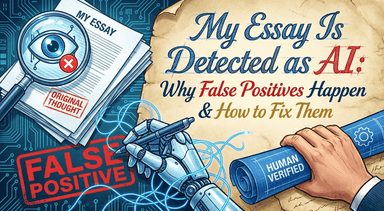
A false positive occurs when the AI flags an action that didn't happen.
- In Physical Recognition: A security camera might interpret two friends high-fiving as a fight.
- In Text Detection: This is a major concern for students. An AI detector might flag a 100% human-written essay as AI-generated simply because the writer used a formal, repetitive style.
Why this matters: False positives can lead to wrongful accusations of cheating or unnecessary security alerts.
The Risk of False Negatives
A false negative happens when the AI misses an action that did occur.
- In Physical Recognition: A self-driving car might fail to see a pedestrian if the lighting is poor.
- In Text Detection: An older tool might fail to catch content generated by a newer model (like GPT-5) because it hasn't been trained on those patterns yet.
Pro Tip: Minimizing Detection Errors
To avoid false accusations or missed detections, use tools updated for the current generation of AI. Outdated detectors often fail against sophisticated models.
High-precision tools like Lynote AI Detector are designed specifically to minimize false positives. They use deep analysis to tell the difference between the nuanced "burstiness" of human writing and the polished monotony of AI.
Factors That Lower Accuracy
Several things can confuse even the best AI systems:
- Ambiguity: Actions that look similar (e.g., stretching vs. reaching) confuse cameras.
- Data Bias: If an AI was trained mostly on English text, it may flag non-native English writing as "AI-generated" due to simpler sentence structures.
- Adversarial Attacks: Humans can intentionally alter their behavior (wearing patterned clothing or inserting deliberate typos) to trick the algorithm.
Ultimately, AI detection is a verification assistant, not a final judge. A human should always review the results to understand the context.
Comparison: Physical vs. Textual Detection Technologies
While both fields fall under "AI Detection," the technology used to identify a person running is fundamentally different from the algorithms that flag AI essays. Physical detection relies on visual data, while textual detection relies on math.
Here is how these two forms of human action detection compare:
| Feature | Physical Action Recognition (HAR) | Textual Action Detection (AI Content) |
|---|---|---|
| Target | The Human Body (Movement, Posture) | The Human Mind (Syntax, Logic) |
| Core Technology | Computer Vision, Sensors, LiDAR | Natural Language Processing (NLP), Burstiness Analysis |
| Input Data | Pixels, Video Frames, Depth Data | Written Words, Sentence Structure |
| Accuracy Rate | High (>95%) – Movements are physically measurable. | Variable (85-98%) – Writing styles vary; detection relies on probability. |
| Primary Use Case | Surveillance, Self-Driving Cars, Healthcare | Academic Integrity, SEO Content, Fake News Detection |
| Main Challenge | Objects blocking the view and poor lighting. | False Positives (identifying human writing as AI). |
Key Takeaway: Physical detection is about observation—seeing what happens in space. Textual detection, championed by tools like Lynote, is about pattern recognition—calculating the odds that a machine predicted your words.
Frequently Asked Questions (FAQ)
Can AI detect if I copy-pasted text?
Yes, in many digital environments. This falls under behavioral analysis. Learning Management Systems (LMS) like Canvas or Blackboard often log "clipboard events." They track the action of inputting text. If an entire essay appears in a text box in 0.1 seconds, the system flags it as a copy-paste action rather than human typing.
Is AI action recognition legal in public spaces?
It depends on where you are. In many areas, standard video surveillance is legal because there is no "expectation of privacy" in public. However, Human Action Recognition (HAR) that uses biometric data (like gait analysis) is heavily regulated.
- EU: The GDPR has strict rules on biometric data.
- USA: Laws vary by state (e.g., Illinois has strict privacy laws).
- China: Public surveillance with action recognition is common.
Can AI detectors identify text written by ChatGPT or GPT-5?
Yes, but you need the right tool. Standard plagiarism checkers cannot detect AI-generated content because AI writes original text rather than copying it. However, specialized AI detectors analyze the syntax and probability of the words used. Tools like Lynote AI Detector are engineered to identify the subtle patterns left behind by advanced models like GPT-4o and Claude.
How accurate is AI in detecting human emotions?
It is accurate but lacks nuance. This field is known as Affective Computing.
- Visual: AI can detect smiles or frowns with high accuracy.
- Textual: Sentiment analysis can easily identify "positive" or "negative" words.
- The Limitation: AI struggles with sarcasm and context. A person might smile out of politeness while feeling angry, or use dark humor that AI mistakes for depression.
Conclusion: The Future of Human Verification
AI has evolved far beyond simple surveillance cameras. As we have seen, the technology can now recognize physical movements through Computer Vision and analyze cognitive patterns through NLP. Whether it is identifying a suspicious walk in a parking lot or distinguishing between a heartfelt email and a chatbot's output, AI is changing how we verify "human action."
However, this technology isn't just about catching robots—it is about preserving authenticity. As AI content becomes harder to spot, the value of genuine human input goes up. The tools of the future are not designed to replace us, but to validate the creativity that only a human mind can produce.
If you are a writer, student, or content creator, protecting the integrity of your work is essential. Don't let algorithms misinterpret your effort.
Verify your text authenticity instantly with Lynote AI Detector.
- 100% Free & Unlimited: Check as many documents as you need.
- No Sign-Up Required: Just paste and analyze.
- Deep Analysis: Detects patterns from GPT-4, GPT-5, Claude, and Gemini.